
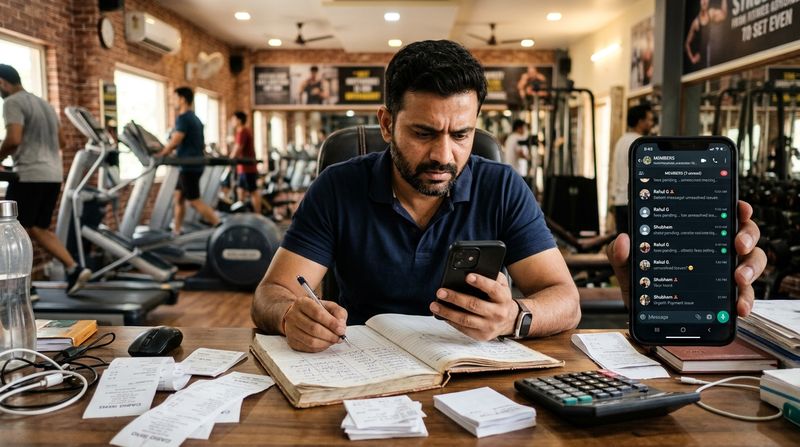
Manual billing quietly drains money from Indian gyms every single month. When your renewal reminders live in a WhatsApp chat, your dues in a notebook, and your GST calculations in your head, revenue slips out through gaps you never see — missed renewals, untracked partial payments, wrong invoices, and defaulters nobody chases. A gym with around 200 members running on manual processes is typically leaving a material sum on the table each month across at least four distinct leak points. This post names each one, estimates what it costs, and shows how automated billing closes the gap.
The sections below cover the four biggest billing leaks, a practical checklist to audit your own gym, and how gym fee tracking software resolves each problem methodically.
Are Missed Renewals Your Biggest Gym Billing Problem?
Yes, for most gyms they are. A member whose membership lapses quietly on the 15th of the month rarely walks in on the 16th to renew unprompted — they simply stop coming. Without an automated alert, your front-desk staff may not notice for days or weeks, and by then the member has mentally moved on.
The maths compounds quickly. If even a small fraction of your active base lapses without follow-up each month, and each lapsed member takes two or three weeks to re-engage (or never does), you lose both the renewal fee and the momentum of that relationship.
What manual billing looks like here: A staff member checks a register, spots that someone's membership ended last week, and sends a WhatsApp message — if they remember. There is no system-generated alert, no escalation, no record of whether the message was read.
What the leak costs (illustrative example):
| Scenario | Detail |
|---|---|
| Gym size | 200 active members |
| Monthly membership value | ₹1,500 per member (illustrative) |
| Members whose renewal is missed for ≥2 weeks | 8 members |
| Revenue at risk per month | ₹12,000 |
| Over 12 months | ₹1,44,000 |
Numbers above are illustrative only, to show the arithmetic. Your actual figures will differ.
Automated renewal reminders — sent via WhatsApp three days before, one day before, and on the expiry date — convert a passive lapse into an active conversation while the member still has a reason to renew.
How Do Untracked Partial Payments Drain Gym Revenue?
Partial payments are extremely common in Indian gyms. A member pays part of a quarterly membership fee and promises the rest next week. In a register, this becomes a pencil note. In a WhatsApp thread, it is buried under fifty other messages. Nobody follows up. The balance is never collected.
The problem is not that gyms offer partial payment — it is that there is no structured tracking. Once a partial amount is logged in a register, it requires a human to remember, locate and chase it. That human is usually your busiest staff member.
Signs you have this problem:
- Your register has amounts scratched out and rewritten
- You have members who always seem to owe "a small amount" but you cannot confirm the exact figure
- Your month-end cash does not match what you expected from memberships sold
Structured billing software records each payment against a specific membership period, shows the outstanding balance instantly on the member's profile, and can trigger a WhatsApp reminder for the due amount automatically. No arithmetic, no memory required.
Are GST Invoice Errors Costing Your Gym Money and Compliance?
GST errors on gym invoices create two problems: compliance risk and lost credibility with members who need valid invoices for reimbursement.
Since 22 September 2025, gym, fitness, health club and yoga services attract 5% GST (charged as 2.5% CGST plus 2.5% SGST within a State, or 5% IGST for interstate supply) under SAC 999723, per the CBIC and the GST Council. This replaced the earlier 18% rate. If your invoices still show the old rate — or if you are generating invoices without SAC codes, without CGST/SGST split, or without your GSTIN — you are producing non-compliant documents.
Gyms required to register (above ₹20 lakh aggregate annual turnover, or ₹10 lakh in special category States) and those above ₹5 crore turnover who must issue e-invoices face the greatest exposure. Confirm your exact obligations with a chartered accountant.
Common manual invoice errors in Indian gyms:
- Wrong or missing SAC code (correct code: 999723)
- Old GST rate still printed on invoice templates
- CGST and SGST not split correctly
- No GSTIN on the invoice
- Advance receipts not issued as receipt vouchers per Rule 50, CGST Rules 2017
- Invoices handwritten or created in a generic Word template with no sequential numbering
Every corrected invoice takes time. Every incorrect invoice is a liability. Automated billing generates GST-compliant invoices with the correct rate, SAC code, CGST/SGST split, and sequential numbering — and exports a GSTR-1 report at month-end.
For a deeper walkthrough of GST rules specific to gyms, read GST for gyms in India: a simple 2026 guide.
Why Do Gym Defaulters Go Unchased on Manual Systems?
Because chasing them requires a person to identify them, find their contact, send a message, log the response, and follow up again — all manually, across dozens of members simultaneously.
On a WhatsApp-and-register system, defaulters accumulate silently. The staff member who should chase them is busy with walk-ins, class scheduling, and equipment issues. By the end of the month, the list of people who owe money is long, the trail is cold, and some have stopped attending entirely.
The follow-up gap by the numbers (illustrative):
| Stage | Manual billing | Automated billing |
|---|---|---|
| Reminder sent before due date | Depends on staff memory | Automatic, WhatsApp |
| Reminder on due date | Rarely | Automatic |
| Overdue alert after lapse | Manual, if at all | Automatic, with dues amount |
| Time to first follow-up | 1–7 days | Same day |
| Staff time per defaulter per month | 10–15 minutes | Near zero |
Illustrative comparison only.
With WhatsApp automation tied to billing, the moment a payment is due or overdue, the member receives a message with the exact amount and a payment link. Staff only step in for members who still haven't paid after the automated sequence.
Also see: how to handle gym payment defaults (without losing members).
What Does Manual Billing Actually Cost a 200-Member Gym Each Month?
Here is a consolidated illustrative estimate. Every figure is made up for the purpose of showing the arithmetic — replace them with your own numbers.
Example: Revenue at Risk for a 200-Member Gym
| Leak | Assumption | Monthly revenue at risk |
|---|---|---|
| Missed renewals | 5% of members lapse without follow-up; avg. membership ₹1,500 | ₹15,000 |
| Untracked partial payments | 10 members with avg. outstanding ₹800 each | ₹8,000 |
| Defaulters not chased | 8 members with avg. dues ₹1,200 each | ₹9,600 |
| GST invoice corrections & goodwill discounts | 2 hours of staff time + ad-hoc discounts | ₹3,000 (est.) |
| Total monthly leakage | ₹35,600 |
All figures above are illustrative only. Your gym's actual losses depend on your membership mix, pricing and follow-up practices.
Use the gym payment recovery calculator to plug in your own numbers and see what you are leaving behind.
Billing Audit Checklist for Indian Gym Owners
Run through this before your next billing cycle:
- Do you know, right now, how many members have dues outstanding and the exact amount each owes?
- Can you pull a list of memberships expiring in the next seven days without opening a register?
- Does every invoice you issue carry your GSTIN, SAC code 999723, and the correct CGST/SGST split?
- Is every partial payment logged against a specific member and membership period?
- Do members who have not paid receive a follow-up within 24 hours of their due date — without staff having to remember?
- Can a member pay online via UPI, card or netbanking without calling or visiting?
- Does your month-end revenue figure match your expected revenue from memberships sold?
If you answered "no" or "not sure" to more than two of these, your billing process has at least one active leak.
How to Fix Gym Billing Problems in India: Five Practical Steps
-
Centralise all member records in one place. Every membership — start date, end date, amount paid, amount outstanding — needs to live in a single system, not across a register, a WhatsApp group and a staff member's memory.
-
Automate renewal reminders. Set reminders to go out three days before expiry, on the day of expiry, and three days after. WhatsApp has far higher open rates than email for this purpose in India.
-
Issue GST-compliant invoices from day one. Your software should generate the invoice; you should not be building them in Word. Confirm the correct rate and SAC code with your CA, then lock the template.
-
Give members a way to pay without calling you. A member payment link or self-serve portal removes the single biggest friction point in gym fee collection. Members who can pay at 11 pm from their phone are far more likely to pay on time.
-
Review dues weekly, not monthly. A weekly dues review catches problems when they are small. A monthly review finds them when they have compounded. Set a fixed 20-minute slot each week for this.
For context on how gym software specifically addresses revenue leakage for smaller gyms, read how gym software can cut revenue leakage for small gyms.
How MyGymDesk Helps
MyGymDesk's billing and invoicing generates GST-compliant invoices with CGST, SGST and SAC codes automatically, tracks every payment and partial payment against the right member, and exports a GSTR-1 report at month-end. Automatic WhatsApp reminders go out before and after renewals on every plan — no staff action needed. Members can pay by UPI, card or netbanking through the gym's own Razorpay integration, and renew from the member portal any time they like. There is a free trial with no credit card required, or you can book a demo to see the billing workflow in action.
FAQs
Why do Indian gyms lose money on manual billing?
Manual billing relies on staff memory and handwritten records to track renewals, partial payments and defaulters. When reminders are not sent on time, dues are not logged precisely, or invoices are incorrectly prepared, revenue either goes uncollected or creates compliance risk — both of which cost money.
What are the most common gym billing mistakes in India?
The most common are: letting memberships lapse without an automated renewal reminder, not tracking partial payments against individual member accounts, generating GST invoices with the wrong rate or missing SAC codes, and having no structured follow-up system for overdue payments.
What GST rate applies to gym memberships in India?
Gym, fitness, health club and yoga services attract 5% GST (2.5% CGST plus 2.5% SGST within a State, or 5% IGST) under SAC code 999723, effective 22 September 2025, per the CBIC and the GST Council. Confirm your registration threshold and invoice requirements with a chartered accountant.
How can a gym automate billing and payment collection in India?
Gym management software can send automatic WhatsApp reminders before and after renewal dates, generate GST invoices without manual input, track outstanding dues by member, and let members pay online via UPI or card at any time. This removes the dependence on staff memory and follow-up.
How do I know how much revenue my gym is losing to billing gaps?
Start with a dues audit: list every member with an outstanding balance, every membership that lapsed in the last 30 days without renewal, and every invoice issued in the last quarter that did not carry a correct GSTIN and SAC code. The gym payment recovery calculator can help you translate those gaps into a monthly rupee figure.